
LoopDeetect, the reagent range for your pathogen detection
LoopDeetect Listeria monocytogenes, certified AOAC Performance Tested Methods℠ 082603
Why choose LoopDeetect?

Speed
Automated amplification and result interpretation with LoopiX.
90 minutes from sampling to result.

Performance
Performance equivalent to reference methods.
Listeria monocytogenes certified AOAC PTM.

Simplicity
Ready-to-use kits, with no risk of contamination, and no complex handling.
LoopDeetect, a reagent range for pathogen analysis
General kit description
The LoopDeetect reagent comes in the form of a ready-to-use tube, containing a pellet onto which the purified sample is deposited. Each reagent is specific to one target pathogen from the range.
The method carries no risk of contamination: the reagents are single-use, and are meant to be disposed of after amplification.
All our reagents are developed and manufactured in-house in Normandy, in our equipped laboratories and cleanrooms. They can then be stored for 12 months at room temperature.
Know more about LoopDeetect kits
Format:
Sealed pouch containing one reagent tube
Use:
Single-use and ready to use
Specificity:
One dedicated reagent per target pathogen
Matrices:
Surface / Food
Technology:
RT-LAMP
Storage:
12 months at room temperature
Listeria monocytogenes
Certified AOAC Performance Tested Methods℠ 082603
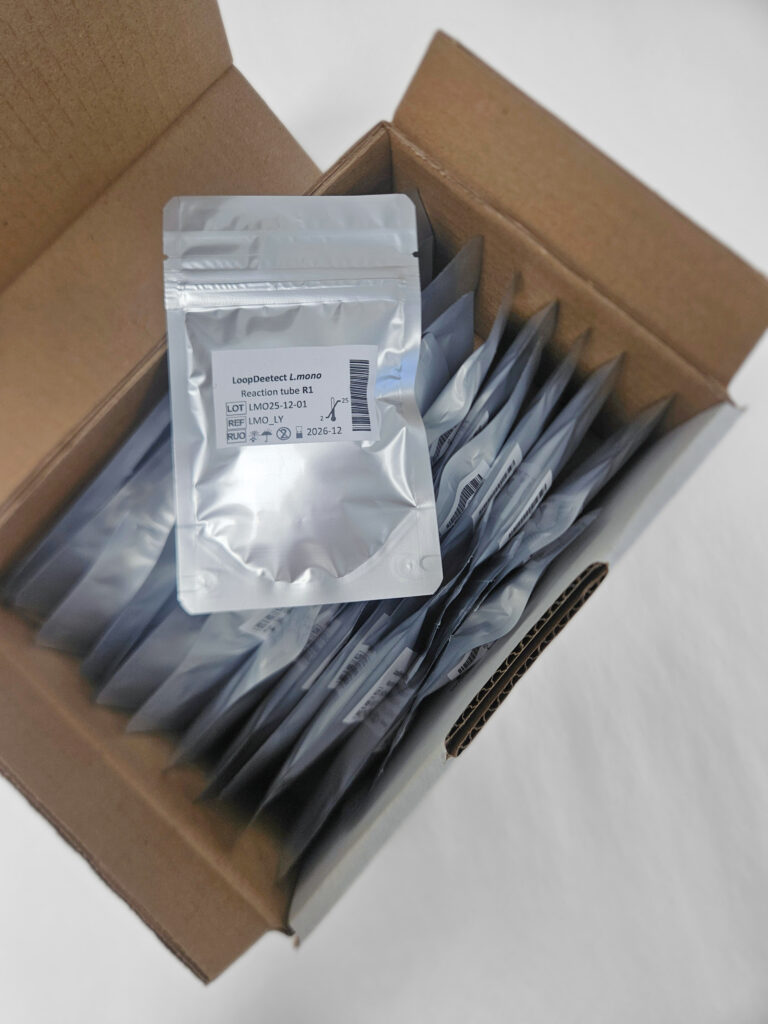
Listeria monocytogenes: AOAC PTM Certified
LoopDeetect Listeria monocytogenes: a field method, certified AOAC Performance Tested Methods℠, capable of delivering a result in under 90 minutes.
This kit benefits from international recognition, a guarantee of reliability for your environmental Listeria monocytogenes controls.
The AOAC Research Institute is a global benchmark for independent validation of food safety methods. This certification confirms that LoopDeetect Listeria monocytogenes performance meets the industry’s most demanding standards.
Information about the certification is available on the AOAC-RI website.
LoopDeetect fits into your complete solution

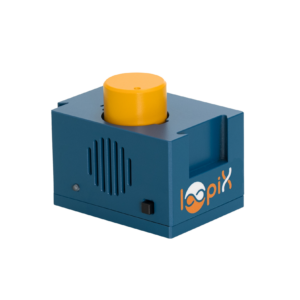
Lysis & amplification device
The lysis and amplification device, at the heart of your detection process.

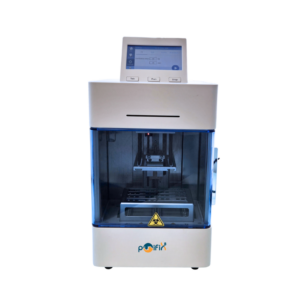
Purification solutions
The purification range that removes inhibitors for reliable results.
Frequently asked questions about LoopDeetect kits
Qu'est-ce que la certification AOAC PTM et pourquoi est-ce important ?
The AOAC Performance Tested Methods℠ is an independent certification program from the AOAC Research Institute, a global benchmark for validating food safety methods. It guarantees that a method’s performance has been evaluated using rigorous protocols, benchmarked against the industry’s reference methods.
Our LoopDeetect method is AOAC PTM certified for the Listeria monocytogenes protocol without enrichment. This means this method, which is simple to use in the field and requires no specific expertise, delivers the same performance as reference methods, with results in under 90 minutes.
Find here the information regarding AOAC PTM certification.
Comment se conservent les kits LoopDeetect ?
LoopDeetect reagents can be stored for 12 months at room temperature from their manufacturing date, thanks to:
- Our rigorous manufacturing protocols,
- Their airtight pouch, which protects them from humidity and light.
Comment interpréter un résultat LoopDeetect ?
If present, the combined action of LoopiX and the LoopDeetect reagent amplifies the target. LoopiX then interprets its presence and gives a result in the form of an LED color code, visible on the front of the instrument and on the monitoring tools.
Based on this result, corrective actions and site protocols are triggered, all within 90 minutes, which helps limit the consequences of contamination.
Un kit LoopDeetect peut-il être utilisé pour plusieurs analyses ?
No, each kit is single-use and ready to use. After amplification, consumables must be disposed of according to site procedures. Since the tube containing the amplified sample is never reopened after amplification, there is no risk of contamination.
Les kits nécessitent-ils un enrichissement préalable ?
Prior enrichment is required only for analyses on products or raw materials (food matrices). This step increases the quantity of microorganisms present before amplification, to ensure reliable detection. On the other hand, for analyses in the production environment (surfaces, equipment), enrichment is not required, allowing our LoopDeetect kits to detect Salmonella spp., Listeria spp., Listeria monocytogenes and E. coli without wasting time.
Quelle est la différence avec les méthodes d'analyse traditionnelles ?
For production environment analysis, no enrichment or culturing is required, which explains the reduced 90-minute turnaround.
For food matrices, both approaches require an enrichment phase. The difference then comes at the detection step. Traditional methods rely on bacterial culturing after enrichment, which extends the total turnaround to 48-72 hours. Our method, based on LAMP technology, enables rapid detection immediately after amplification (around 40 minutes after enrichment), without a lengthy culturing step, for a result in under 24 hours.
This optimization reduces microbiological analysis turnaround in food processing, improves responsiveness in production, and speeds up decision-making in quality control.
Les kits sont-ils compatibles avec tous les environnements industriels ?
Yes. LoopDeetect kits are designed as consumables compatible with all industrial environments. Their ease of use and robustness allow for easy integration in production, quality control, or the laboratory, all while guaranteeing reliable performance regardless of operational constraints.
Existe-t-il un risque de faux positifs ou faux négatifs ?
All LoopDeetect kits deliver performance equivalent to reference methods. Internal validations, as well as validations conducted by a third-party external laboratory, compared the reliability of our method to that of reference methods, demonstrating their equivalence based on the RLoD (Relative Limit of Detection) concept.
Specifically, the RLoD compares a method’s performance to the reference method. An RLoD below 2.5 (unpaired samples) or 1.5 (paired samples) indicates that the tested method produces results equivalent to those of the reference method. Limits of detection (LoD) are therefore identical to those of the reference method (which can vary depending on the matrix, as with the reference method).
For Listeria monocytogenes, this reliability is further reinforced by the AOAC Performance Tested Methods℠ certification, an additional guarantee of the robustness of the results obtained.
Have a specific pathogen detection need?
Our teams will help you find the right solution for your production.