
Salmonella in dry products: why your detection methods may have blind spots
Published: October 22, 2026
What if Salmonella were still there, invisible to your method?
In low water activity (Aw) products, this scenario is documented in the scientific literature. And it affects far more manufacturers than you might think.
This article is an invitation to understand how methods and pathogens behave in a specific context. Here, that of dry matrices, so you can adapt your control plans accordingly.
Want to learn more about Salmonella?
Salmonella and low-Aw products: a poorly understood relationship
Water activity (Aw) measures the amount of water available in a food on a scale from 0 to 1.
The minimum growth limit for Salmonella is about 0.94.
Source: ANSES, Biological hazard fact sheet for foodborne hazards – Salmonella spp., Referral No. 2016-SA-0080, updated June 2021
Dry products have an Aw well below this threshold:
- Spices, powders, flours, cereals: Aw between 0.1 and 0.6.
- Chocolate, sesame-based products, tree nuts: variable Aw but generally below 0.70.
The logical conclusion seems obvious: no growth possible, therefore no risk. This is where the reasoning breaks down.
Salmonella does not multiply in these matrices. But it survives there. For months, sometimes years.
This is no trivial nuance. It is the basis of a structurally underestimated risk in many control plans.
Source: EFSA Journal, 2024 – Persistence of microbiological hazards in food and feed production and processing environments – DOI 10.2903/j.efsa.2024.8521
To go further on detection methods and how to integrate them into an HACCP plan:
Desiccation stress: how it changes Salmonella's behavior
When Salmonella is exposed to low water activity, it doesn’t stay passive. It adapts, and this adaptation makes it both harder to detect and harder to eliminate.
The genetic and physiological response
When Salmonella is placed in a low-Aw environment, it doesn’t passively endure the stress. It deeply reorganizes its biological functioning: hundreds of genes are activated, notably those involved in cell survival and virulence.
In plain terms: a Salmonella stressed by desiccation remains dangerous. And in a state of stress, Salmonella maintains a high level of RNA expression. This signal is detectable by RNA-based methods (RT-LAMP), even at low concentration and on non-culturable cells.
Source : Mandal & Kwon, 2017 – Global Screening of Salmonella enterica Serovar Typhimurium Genes for Desiccation Survival – Frontiers in Microbiology – DOI 10.3389/fmicb.2017.01723
Cross-resistances induced by low Aw
Exposure to a dry environment doesn’t just strengthen resistance to dryness. It makes Salmonella harder to eliminate on several fronts at once:
- Heat: its thermal resistance increases, reducing the effectiveness of conventional heat treatments.
- Disinfectants: sodium hypochlorite and hydrogen peroxide, two common active agents in the food industry, become less effective.
- Bile salts: its digestive resistance increases, strengthening its ability to cause infection once ingested.
- UV radiation: protection against UV treatments is also increased.
Source : Jiawen Zhang et al., 2023 – Current Perspectives on Viable but Non-Culturable Foodborne Pathogenic Bacteria: A Review – MDPI
Easier biofilm formation
Certain Salmonella serovars adapt particularly well to low-Aw environments. Desiccation increases the capacity to form biofilm, and massively activates a cellular defense mechanism that lets the bacterium better withstand all external aggressions and become harder to neutralize.
Source : Ahmed Abdelhamid et al., 2020 – Collateral adaptive responses induced by desiccation stress in Salmonella enterica – LWT Food Science and Technology – DOI 10.1016/j.lwt.2020.110781
The VBNC state: the main cause of false negatives
Under desiccation stress, Salmonella can enter a VBNC (Viable But Non-Culturable) state: the cells are alive, metabolically active, and retain their pathogenic capacity. But they no longer grow on conventional culture media.
Source : Sarah Finn et al., 2013 – Mechanisms of survival, responses and sources of Salmonella in low-moisture environments – Frontiers in Microbiology – DOI 10.3389/fmicb.2013.00331
What the VBNC state means in practice for detection
Conventional detection methods (culture-based and even most rapid methods) rely on the same principle: pre-enrichment and selective enrichment to amplify low cell counts and revive damaged cells.
In dry matrices, this approach faces several cumulative obstacles:
- Abrupt rehydration can kill cells before they multiply. Osmotic shock on contact with the enrichment broth can be lethal for cells already weakened by desiccation. Rehydration temperature and duration are critical.
- Inhibitory compounds in certain matrices. Herbs, spices, and dried onions contain phenolic compounds that can suppress Salmonella growth in enrichment cultures.
- The VBNC state in flours and cereals. Processing and storage conditions for flour-based products induce environmental stresses that favor bacteria entering the VBNC state. The existence of VBNC cells causes false negative detections with traditional culture methods.
Source : Md Fakruddin et al., 2013 – Salmonella Detection and Identification Methods for Food – Rapid Microbiology – NIH
Source : Yanmei Li et al., 2020 – Reduction, Prevention, and Control of Salmonella enterica VBNC Cells in Flour Food – Frontiers in Microbiology – DOI 10.3389/fmicb.2020.01859
Result: your method says negative. The risk is still there.
The infectious dose: a risk amplified in fatty matrices
In matrices with high fat content and low Aw (chocolate, peanut butter, tahini, halva), the infectious dose of Salmonella can be as low as 1 to 45 cells.
This figure radically changes risk assessment. Very low residual contamination, undetected by a conventional method facing VBNC cells, can be enough to cause an infection.
Cases documented by health authorities confirm it. In 2022, EFSA and ECDC investigated a multinational outbreak of monophasic S. Typhimurium linked to chocolate products: 324 confirmed cases in 12 European countries, mainly affecting children under 10.
Source : Encyclopedia.pub, Salmonella enterica Outbreaks from Tahini and Tahini-Based Products, 2022
Source : ECDC/EFSA Rapid Outbreak Assessment – Multi-country outbreak of monophasic Salmonella Typhimurium ST34 linked to chocolate products – May 18, 2022 – DOI 10.2903/sp.efsa.2022.EN-7352
What this means for your control plans
The manufacturers who truly understand how pathogens behave in their matrices are the ones who make the best decisions.
Here are the concrete implications of what the documented science on Salmonella in dry environments teaches us:
- Revisit your environmental sampling strategy. In workshops producing dry matrices, environmental monitoring plans must take into account the specific behavior of Salmonella in this context.
- Question the relevance of the detection method used. If your method relies on standard selective enrichment, it may generate false negatives in low-Aw matrices. This is a structural blind spot, not a user error.
- Consider RNA-based methods. As documented by Mandal & Kwon (2017), Salmonella under stress maintains high RNA expression, which allows RT-LAMP methods to detect it even in a VBNC state, without pre-enrichment.
Conclusion
Salmonella in low-moisture products is not a theoretical risk. It is a documented risk, with precise biological mechanisms, real cases, and concrete implications for control plans.
The first step is to understand why conventional methods have limits in this context. The second is to adapt detection strategies accordingly.
LoopDeetect Salmonella spp.: a concrete answer to this problem
The limits of conventional methods in dry matrices are not inevitable. They call for an adaptation of the analytical approach.
LoopDeetect Salmonella spp. is based on RT-LAMP (Reverse Transcription Loop-mediated isothermal AMPlification) technology, which directly targets the pathogen’s RNA rather than its growth on culture media.
This point is fundamental in the context of low-Aw products: as documented by Mandal & Kwon (2017), Salmonella under stress maintains high RNA expression, including in a VBNC state. This is precisely the signal LoopDeetect picks up.
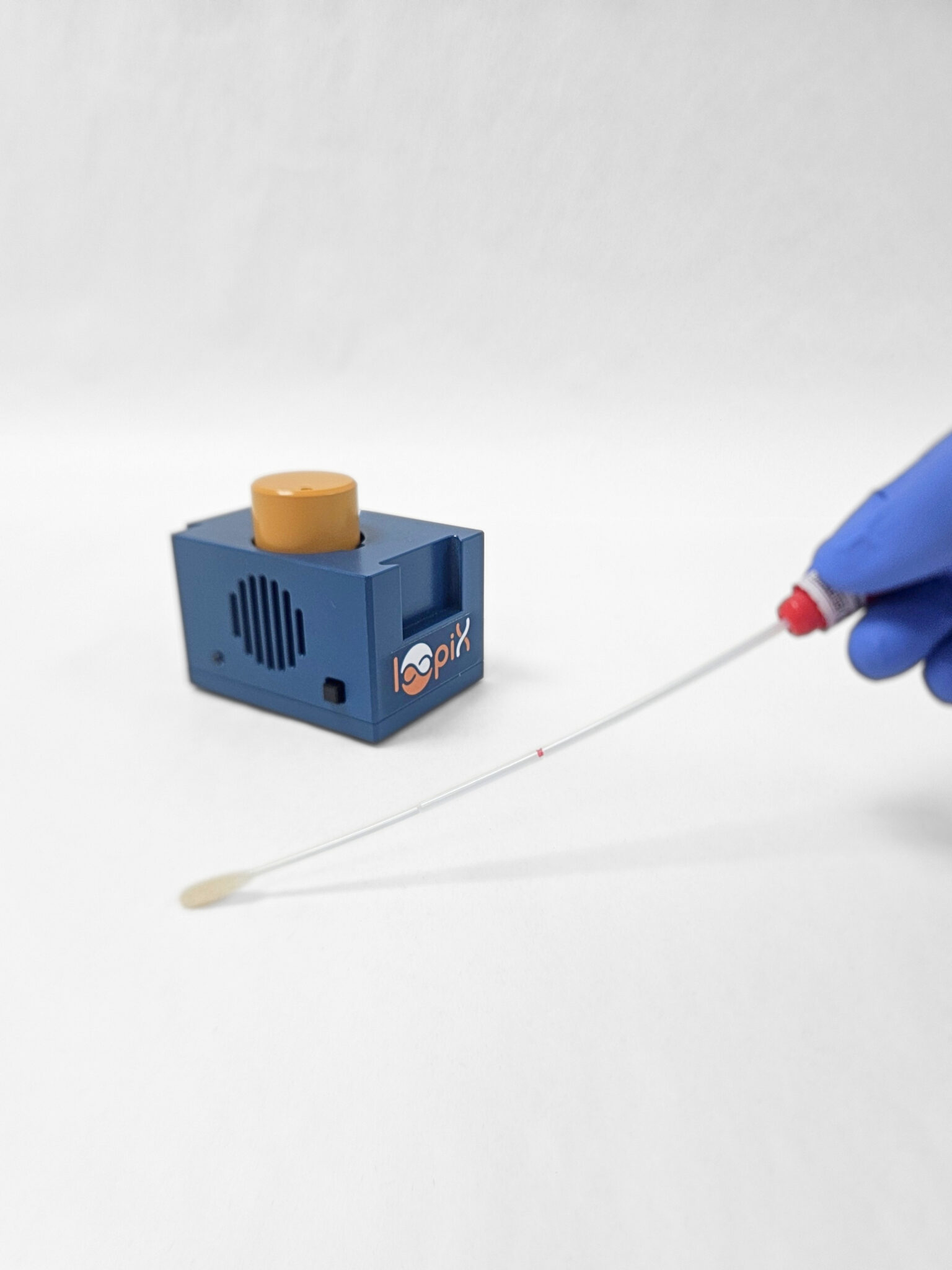
What this changes in practice:
- No dependence on cell culture: VBNC cells, invisible to conventional methods, remain detectable.
- Result in under 90 minutes: versus a minimum of 48 to 72 hours with methods based on selective enrichment.
- On-site, with no lab equipment: detection integrates directly into routine control practices, with no sending samples to an external lab.
- No pre-enrichment for environmental swabs: a direct operational advantage in workshops producing dry matrices.
Sources
- ANSES, Referral No. 2016-SA-0080 (June 2021)
- EFSA Journal, 2024, DOI 10.2903/j.efsa.2024.8521
- Mandal & Kwon, Frontiers in Microbiology, 2017, DOI 10.3389/fmicb.2017.01723
- Jiawen Zhang et al., MDPI, 2023
- Ahmed Abdelhamid et al., LWT Food Science and Technology, 2020, DOI 10.1016/j.lwt.2020.110781
- Sarah Finn et al., Frontiers in Microbiology, 2013, DOI 10.3389/fmicb.2013.00331
- Yanmei Li et al., Frontiers in Microbiology, 2020, DOI 10.3389/fmicb.2020.01859
- Md Fakruddin et al., NIH, 2013
- Encyclopedia.pub, 2022
- ECDC/EFSA, EN-7352, May 18, 2022